 KRAAIPUNT
 KRAAIPUNT
Wil jij meer te weten komen over kraaiachtigen? Dan vind je hier meer informatie en wat tips en links!
Spring naar: Mythologie en folklore | Intelligentie | Vriendjes worden met een kraai
Van alle dieren in het wild zijn vogels het meest verknoopt met ons mensenbestaan. Weinig dieren hebben in de cultuur van, zeg maar rustig, alle volkeren zóveel invloed gehad, zóveel stof tot verhalen, mythes en sprookjes geleverd als vogels. Van de machtige arend tot de kwetsbare duif en alle soorten daartussen. Geen enkele vogelfamilie echter heeft zó'n zwaar stempel op de menselijke geschiedenis gedrukt als de kraaiachtigen, de raaf voorop.
Raven leerden de mens, volgens de Bijbel, om hun doden te begraven. Toen Kain dagenlang had rondgesjouwd met het rottende lijk van zijn vermoorde broer Abel, stuurde God raven om hem de kunst van begraven te leren. Eén raaf doodde een ander en krabde daarna een graf uit, legde zijn dode soortgenoot erin en bedekte hem met aarde.
Bij de oude Egyptenaren deden raven dienst als boodschappers. Ze stonden in hoog aanzien.
En volgens tal van overleveringen was de raaf vroeger wit; in Scandinavië zou dat tot zeker de zeventiende eeuw de gewoonste zaak zijn geweest. De Vikingen gebruikten op hun rooftochten raven als "kompas": zoals de duif op Noah's ark. Van die arkduiven-rol bestaat ook weer een raven-variant.
In de meeste oude culturen was de raaf een verheven wezen, begaafd met alwetendheid en voorspellende vermogens. Hij stond dus in hoog aanzien. Dat keerde 180 graden met de opkomst van het christendom. Sindsdien worden alle kraaiachtigen geassocieerd met de dood, de duivel en epidemieën. Ze staan voor zwarte magie, tovenarij, boodschappers van onheil.
In de Middeleeuwen zou het gewoonte geweest zijn om levende kinderen in muren in te metselen om gebouwen zo voor onheil te behoeden. Bij oude slotburchten zie je sindsdien troepen kauwen die er schreiend omheen vliegen: het zijn de wrede metselaars die voor straf in vogels waren veranderd.
(bron: Raven en kraaien van godenvogels tot duivelskinderen op vogelbescherming.nl )
Alles gaat mis wanneer een witte raaf op de thermiek van de godenberg Olympus afglijdt naar de sterfelijke Griekse valleien. Een trouwe vogel; hij handelt in opdracht van Apollo, een god die geen nee verdraagt. Apollo verdenkt zijn zwangere minnares Coronis van ontrouw. De witte Olympusraven zijn Apollo's ogen op de wereld. Zijn gevleugelde dienaar slaat gade en keert dan terug naar godenland met slecht nieuws.
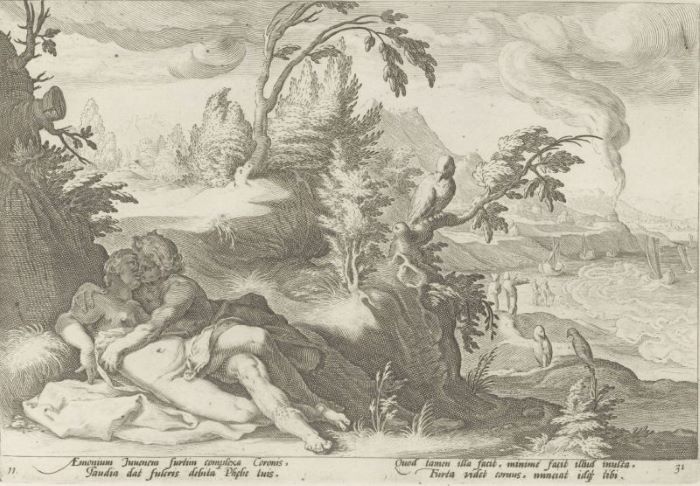
Een achttiende-eeuwse tekening plaatst de witte raaf op een boomtak centraal in de compositie, met het flikflooiende mensenkoppel in de schaduw van de zijkant. In een woedeuitbarsting doodt de god zijn geliefde en haar minnaar. De trouwe raaf maakt de fatale fout dicht bij zijn meester te blijven en ontsnapt niet aan Apollo's toorn: in een gewelddadige vlaag van woede schroeit hij de vogel zwart.
(Phoebus is hier Apollo)
Bk II:531-565 The Raven and the Crow
The gods of the sea nodded their consent. Then Saturnia, in her light chariot drawn by painted peacocks, drove up through the clear air.
These peacocks had only recently been painted, when Argus was killed, at the same time that your wings, Corvus,
croaking Raven, were suddenly changed to black, though they were white before. He was once a bird with silver-white plumage,
equal to the spotless doves, not inferior to the geese, those saviours of the Capitol with their watchful cries, or the swan,
the lover of rivers. His speech condemned him. Because of his ready speech he, who was once snow white, was now white's opposite.
Coronis of Larissa was the loveliest girl in all Thessaly. Certainly she pleased you, god of Delphi. Well, as long as she was faithful, or not caught out. But that bird of Phoebus discovered her adultery and, merciless informer, flew straight to his master to reveal the secret crime. The garrulous Crow followed with flapping wings, wanting to know everything, but when he heard the reason, he said 'This journey will do you no good: don't ignore my prophecy! See what I was, see what I am, and search out the justice in it. Truth was my downfall.
Once upon a time Pallas hid a child, Erichthonius, born without a human mother, in a box made of Actaean osiers. She gave this to the three virgin daughters of two-natured Cecrops, who was part human part serpent, and ordered them not to pry into its secret. Hidden in the light leaves that grew thickly over an elm-tree I set out to watch what they might do. Two of the girls, Pandrosus and Herse, obeyed without cheating, but the third Aglauros called her sisters cowards and undid the knots with her hand, and inside they found a baby boy with a snake stretched out next to him. That act I betrayed to the goddess. And this is the reward I got for it, no longer consecrated to Minerva's protection, and ranked below the Owl, that night-bird! My punishment should be a warning to all birds not to take risks by speaking out.
Bk II:566-595 The Crow's story
And just think, not only had I not asked for her favour, she had sought me out, of her own accord! - Ask Pallas herself:
though she is angry, she will not deny it even in anger. The famous Coroneus was my father, in the land of Phocis
(it is said to be well known) and I was a royal virgin and wealthy princes courted me (so do not disparage me). But my beauty hurt me.
Once when I was walking slowly as I used to do along the crest of the sands by the shore the sea-god saw me and grew hot.
When his flattering words and entreaties proved a waste of time, he tried force, and chased after me.
I ran, leaving the solid shore behind, tiring myself out uselessly in the soft sand. Then I called out to gods and men.
No mortal heard my voice, but the virgin goddess feels pity for a virgin and she helped me. I was stretching out my arms to the sky:
those arms began to darken with soft plumage. I tried to lift my cloak from my shoulders but it had turned to feathers with roots deep in my skin.
I tried to beat my naked breast with my hands but found I had neither hands nor naked breast.
I ran, and now the sand did not clog my feet as before but I lifted from the ground, and soon sailed high into the air. So I became an innocent servant of Minerva. But what use was that to me if Nyctimene, who was turned into an Owl for her dreadful sins, has usurped my place of honour? Or have you not heard the story all Lesbos knows well, how Nyctimene desecrated her fathers bed? Though she is now a bird she is conscious of guilt at her crime and flees from human sight and the light, and hides her shame in darkness, and is driven from the whole sky by all the birds.
Bk II:596-611 Coronis is betrayed and Phoebus kills her
To all this, the Raven replied 'I pray any evil be on your own head. I spurn empty prophecies' and, completing the journey he had started,
he told his master he had seen Coronis lying beside a Thessalian youth. The laurel fell from the lover's head on hearing of the charge,
his expression and colour and the tone of his lyre changed, and his mind boiled with growing anger. He seized his usual weapons,
strung his bow bending it by the tips, and, with his unerring arrow, pierced the breast that had so often been close to his own.
She groaned at the wound, and as the arrow was drawn out her white limbs were drenched with scarlet blood and she cried out
'Oh Phoebus it was in your power to have punished me, but to have let me give birth first: now two will die in one.'
She spoke, and then her life flowed out with her blood. A deathly cold stole over her body, emptied of being.
(bron: Uit "Metamorphoses Book II" (A. S. Kline's Version))
Kraaien zijn erg intelligent en maken gebruik van hun hersenen om aan voedsel te geraken. Zo zijn er verschillende gevallen bekend van kraaien die okkernoten laten vallen op het wegdek in de hoop dat de schaal breekt. Af en toe lukt dat, vaak ook niet. Soms hebben ze geluk en knapt een auto het zware werk voor hen op. Ze halen de buit dan binnen als het verkeer weer stilstaat.
(bron: Zwarte Kraai op onzenatuur.be)
Klik hier voor een filmpje waar kraaien noten kraken met het verkeer. In dit filmpje word de intelligentie extra in de kijker gezet omdat de kraai beseft dat de auto's stoppen en rijden aan verkeerslichten.
Als onderdeel van hun intelligentie hebben kraaien complexe sociale banden met elkaar en kunnen ze gezichten en gedrag van mensen herkennen en onthouden. Dit wil zeggen dat je vriendjes kan worden met kraaiachtigen!
Klik hier voor het coole verhaal van Gabi Mann, 8 jaar oud meisje dat de harten van de kraaien in haar buurt wist te veroveren.